Search
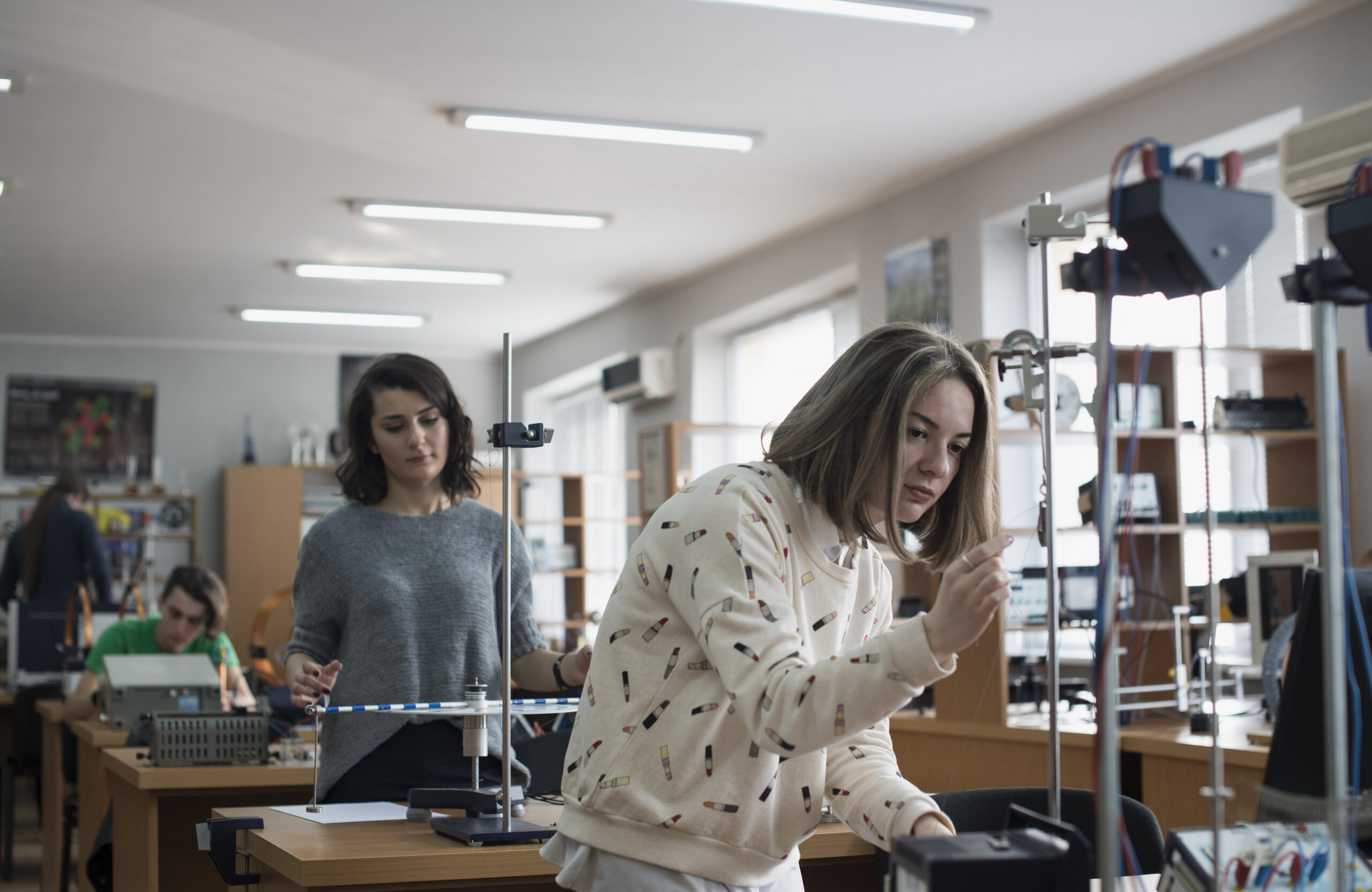

The Physics and Astronomy Master’s Program aims to prepare a new generation of researchers who will acquire a deep and systematic understanding of current issues, modern approaches, and methods in physics and astronomy. Graduates will specialize in one of the program’s concentrations (elementary particle physics, theoretical astrophysics, cosmology and gravitation, condensed matter physics, astronomy and astrophysics, atmospheric and ionospheric physics, biophysics). They will be able to conduct independent research in their chosen field. This creates the prerequisite for graduates to be competitive in both the job market and for further studies after completing the program.
The Physics and Astronomy Master’s Program provides deep and systematic knowledge of both the fundamental laws and principles of physics, as well as current issues, achievements, and problems in the chosen concentration:
Degree awarded: Master of Science in Physics
Language of instruction: Georgian
Program duration: 120 ECTS credits, 4 semesters
The program is led by highly qualified academic staff who represent leading scientists in physics and astronomy with high citation indices and extensive research and practical experience. They actively collaborate with leading universities in Europe and the USA.
The program aims to prepare graduates who will be able to apply numerical and analytical mathematical methods to theoretical models of physical phenomena and solve complex physics problems, including through computer programs; provide conceptual descriptions of complex physical processes, data processing, and interpretation of results; and plan and implement theoretical, experimental, observational, or combined research projects within the chosen concentration using appropriate instruments and methods.
Modern technologies and their development rely on knowledge and the application of physics. Students have the opportunity to deepen their knowledge in areas of interest according to the diverse concentrations available in the program:
Academic staff involved in the program represent leading research institutes and centers in Georgia. They also have connections with universities and research centers in Europe and the USA, which gives students the opportunity to engage in scientific projects and complete scientific work in highly productive research teams.
Students will have opportunities to participate in practical and research programs at European universities, thereby gaining competitive benefits in the international market. The program actively collaborates with Jülich Research Center (Germany).
Professor Andria Rogava – andria.rogava@iliauni.edu.ge
Professor Giorgi Japaridze – gia_japaridze@iliauni.edu.ge
Professor Teimuraz Zaqarashvili – temury.zaqarashvili@iliauni.edu.ge
Professor Tinatin Kakhniashvili – tinatin@iliauni.edu.ge
Associate Professor Zurab Tavartkiladze – zurab.tavartkiladze@iliauni.edu.ge
Professor Nunu Metreveli – nunu_metreveli@iliauni.edu.ge
Associate Professor Maia Todua – mayatodua@iliauni.edu.ge
Graduates with a Master of Science in Physics can continue their studies at the doctoral level or be employed:
Students wishing to pursue a master’s degree must hold a bachelor’s degree or equivalent academic qualification in:
Admission to the master’s program is conducted in two stages:
During the internal university oral examination, knowledge of physics and mathematics is assessed, as well as motivation, communication, and reasoning skills. English language proficiency at the field-specific level is also tested at the B1 level.
Applicants will be evaluated based on:
Within the Physics and Astronomy Master’s Program, students choose one concentration:
⮚ Students of all concentrations must complete the common block mandatory courses – 30 credits (PHYSGEN)
⮚ During the fourth semester, prepare and defend a master’s thesis at the end of the semester – 30 credits
According to the chosen concentration, students must accumulate 90 credits according to the following structure:
Elementary Particle Physics
Theoretical Astrophysics
Condensed Matter Physics
Astronomy-Astrophysics
Cosmology and Gravitation
Atmospheric and Ionospheric Physics
Biophysics